
Pharmaceutical Competitive Intelligence: The Strategic Enabler Function
Intelligence That Turns Signals into Strategy
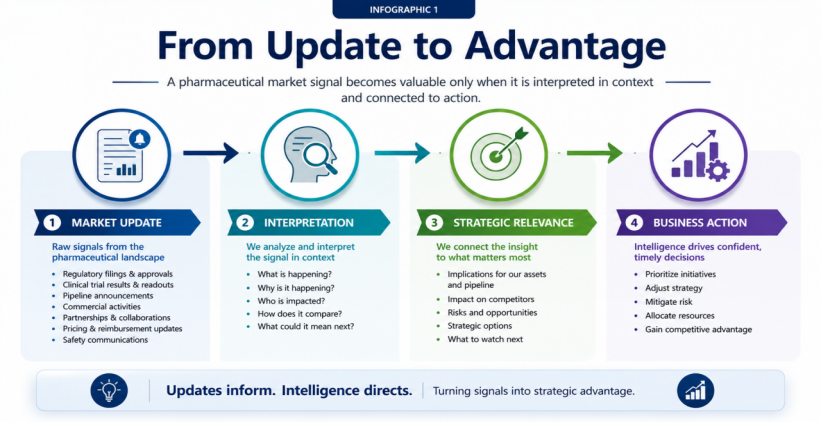
Pharmaceutical markets rarely change without warning. They move through signals: a product approval, a regulatory decision, a clinical milestone, a label change, a safety update, a market access shift, or a competitor activity. Individually, these developments may appear as routine updates. Collectively, they reveal the direction of the market.
This is the core value of pharmaceutical competitive intelligence. It transforms fragmented information across the pharmaceutical competitive landscape into strategic clarity. For decision-makers, the objective is not simply to know what changed. The objective is to understand what that change means for competition, portfolio value, launch timing, market access, lifecycle planning, and business growth.
In a market where science, regulation, and commercial strategy are closely connected, intelligence is no longer a support activity. It is a leadership capability.
Why Competitive Intelligence Belongs in the Boardroom
Pharmaceutical leaders are operating in a landscape defined by intensified competition, regulatory transparency, scientific acceleration, and commercial complexity. In this environment, access to information is no longer the differentiator. The advantage lies in interpreting competitive signals early and translating them into strategic action.
A regulatory decision can influence launch sequencing. A label change can reshape positioning. A competitor milestone can alter portfolio assumptions. A safety signal can affect confidence across a product class. A market access development can change pricing, reimbursement, and revenue expectations.
This is why pharmaceutical competitive intelligence must move beyond monitoring. It should equip leadership teams to answer three boardroom-level questions: what has changed, why it matters, and what action is required.
When delivered with clarity, competitive intelligence becomes a strategic management capability. It supports sharper prioritisation, faster decisions, stronger competitive positioning, and more disciplined resource allocation.
In scientific terms, competitive intelligence acts as an early diagnostic marker for the market—identifying where pressure is building, where risk is emerging, and where strategic intervention may be needed.
From Fragmented Data to Decision-Ready Intelligence
One of the biggest challenges in pharma is not lack of information. It is the volume of disconnected information. Approval databases, regulatory updates, product labels, clinical trial registries, company announcements, safety notices, scientific publications, and access-related developments all provide useful data. But data alone does not create advantage.
Information says, "This happened." Intelligence asks, "What does this change?" That difference is critical.
Product approval should not only be seen as an isolated event. It should raise strategic questions. Does it validate a pathway? Does it strengthen a competitor? Does it create a new benchmark? Does it change future expectations in the therapeutic area?
A label change should not only be read as a regulatory update. It may affect differentiation, prescribing confidence, access discussions, and commercial positioning. A competitor movement should not only be tracked. It should be interpreted in the context of speed, intent, capability, and market impact. This is the shift from reporting to intelligence.
Reading the Full Pharmaceutical Competitive Landscape
A strong intelligence view should not be limited to one product category or one type of update. It should capture movement across the full pharmaceutical competitive landscape.
That means looking at innovation trends, regulatory activity, clinical development signals, product lifecycle movement, competitive positioning, market access pressure, and changes in evidence expectations. The value comes from connecting these signals into a wider view of market direction.
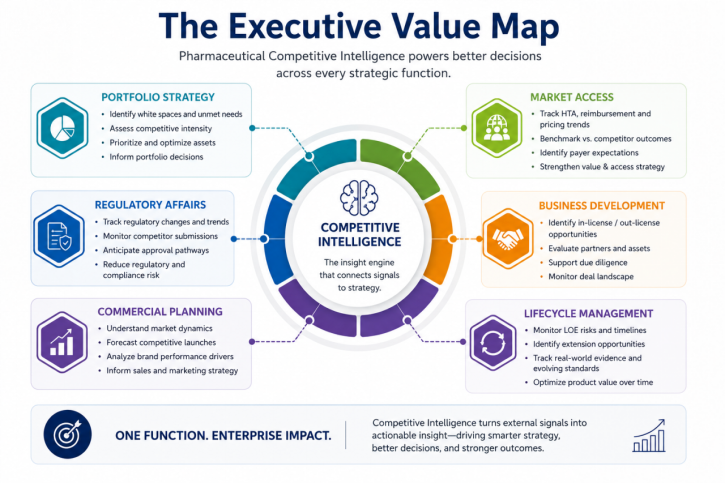
For executives, this broader lens helps identify where opportunities are emerging and where competition is intensifying. For regulatory teams, it supports pathway benchmarking and agency expectation tracking. For portfolio teams, it highlights exposure and future risk. For commercial and market access teams, it supports positioning, pricing assumptions, and launch readiness. For business development teams, it strengthens asset evaluation and deal confidence.
The same signal may mean different things to different teams. The role of competitive intelligence is to connect those meanings and make them actionable.
One Signal, Multiple Decisions
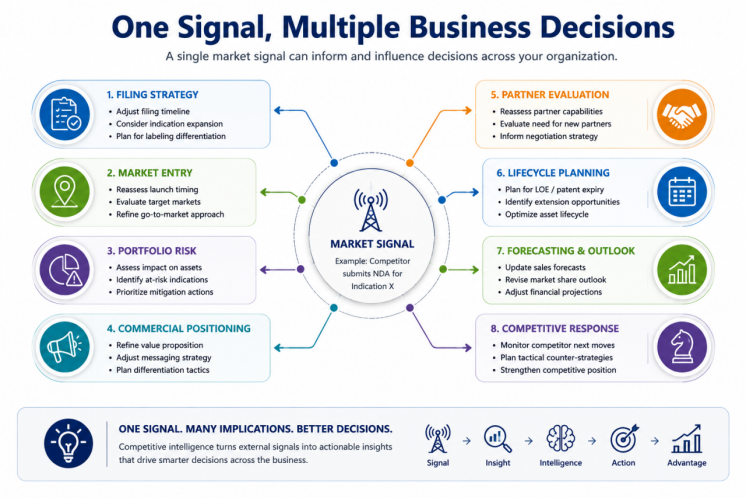
A single signal can influence many decisions across the organisation. A regulatory milestone may support filing strategy, market entry planning, portfolio review, commercial forecasting, partner evaluation, and lifecycle strategy. A safety update may affect medical positioning, risk planning, stakeholder communication, and competitive assumptions. A market access shift may influence pricing strategy, launch sequencing, and revenue expectations.
This is why competitive intelligence should be viewed through an enterprise lens. In science, a small molecular change can alter the behaviour of an entire system. In pharmaceutical markets, one well-timed signal can reshape the competitive landscape. The advantage belongs to teams that identify the signal early, interpret it correctly, and act before the market fully reacts.
The Intelligence Framework: Track. Compare. Interpret. Act.
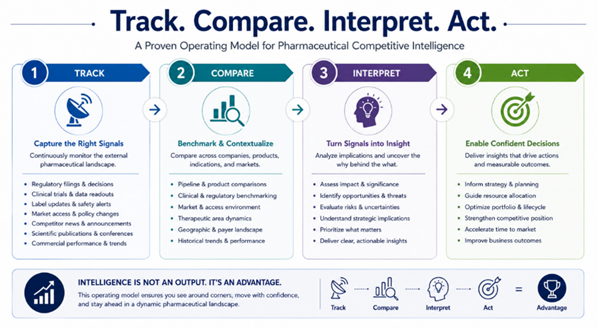
A practical pharmaceutical intelligence model follows a simple rhythm: track, compare, interpret, and act.
First, track the right developments across products, companies, markets, regulatory pathways, therapeutic areas, labels, safety signals, and access dynamics. Tracking creates visibility.
Second, compare the information across relevant dimensions such as competitor, geography, timeline, product position, market relevance, and strategic impact. Comparison creates context.
Third, interpret what the movement means. Is a competitor gaining speed? Is a market becoming crowded? Are expectations changing? Is portfolio risk increasing? Is a new opportunity emerging? Interpretation creates insight.
Finally, act. Use the intelligence to support better decisions in development planning, regulatory strategy, market entry, portfolio prioritisation, commercial execution, lifecycle management, and business development.
The framework is simple, but powerful: track what matters, compare it intelligently, interpret the signal, and act with confidence.
Read the Market Before the Market Reacts
The pharmaceutical market is already speaking through signals. Some are scientific. Some are regulatory. Some are commercial. Some are competitive. The source may differ, but the strategic question remains the same: what does this mean for the market, and what should be done next?
Pharmaceutical competitive intelligence helps answer that question. It turns scattered updates into structured understanding. It turns market movement into business meaning. It turns signals into management action.
For leaders, the opportunity is clear: read earlier, interpret sharper, and move smarter.
In today’s pharmaceutical environment, a complete view of the competitive landscape requires intelligence that is structured, contextual, and decision ready. GlocalCI serves as a trusted strategic intelligence partner, helping organisations translate complex market signals into actionable direction across portfolio, regulatory, commercial, market access, and lifecycle decisions.